How to Perform a 6-Point Truck Insurance Audit
Step-by-step guide to auditing your truck insurance policy. Check cargo limits, operating radius, deductibles, exclusions, physical damage, and market price — find $600+/year in savings.
Why Audit Your Insurance Policy Every Year
Most owner-operators auto-renew their insurance every year. Your insurer is counting on this. Insurance companies routinely overcharge small fleets and OOs by $600+/year through inflated premiums, unnecessary coverage, and rating errors. A single policy audit at renewal time is the best investment you can make — the average savings is $600/year, and the process takes 30 minutes.
- 1Find your current declarations page (dec page) or ACORD certificate — insurers email this at renewal
- 2Open TruckerProfit Insurance Auditor or print this checklist
- 3Gather your last 3 years of loss runs from your insurer (they must provide them by law)
Point 1: Cargo Limit — Are You Overinsured?
- 1Check your cargo insurance limit — most brokers require $100,000
- 2If your policy shows $250,000 cargo limit and your freight never exceeds $100K per load, you're overpaying
- 3Check your broker agreements — the maximum cargo liability is usually specified in each contract
- 4Reduce your cargo limit to match actual requirements and save $200-400/year
Pro Tip
Some specialized freight (electronics, pharmaceuticals) genuinely requires $250K+. Check your actual loads before reducing coverage.
Point 2: Radius of Operation
- 1Find the radius listed on your dec page (100mi, 200mi, 500mi, unlimited)
- 2Compare against your actual operating area for the last 6 months
- 3If you run regional (500mi radius) but have 'unlimited' on your policy, you're overpaying significantly
- 4Call your agent and update the radius to match your actual operations
Point 3: Deductibles — Find the Sweet Spot
- 1Check your physical damage deductible — standard is $1,000 but many policies default to $500
- 2A $500 deductible vs $1,000 costs 15-20% more in premium
- 3If you have $50K+ in savings, consider raising to $2,500 to save $300-500/year
- 4Check your liability deductible — raising from $5K to $10K saves $400-800/year
Warning
Never raise a deductible beyond what you can comfortably pay out of pocket. If a $2,500 deductible would cause financial strain, keep the lower deductible.
Point 4: Exclusions — What's NOT Covered
- 1Read the exclusions section of your policy — this is where surprises hide
- 2Check for 'non-owned trailer' exclusion — your trailer isn't covered when pulled by another truck
- 3Check for 'hired auto' exclusion — rental trailers aren't covered
- 4Check who's listed as authorized drivers — excluded drivers void coverage for the entire trip
Point 5: Physical Damage — ACV vs Stated Value
- 1Find your physical damage coverage type: Actual Cash Value (ACV) or Stated Value
- 2ACV pays depreciated value — fine for trucks 10+ years old
- 3Stated Value pays an agreed amount — costs more but protects newer trucks
- 4If you have a 12-year-old truck on Stated Value, you may be overpaying
Point 6: Market Benchmark Test
- 1Note your annual premium and divide by 12 for monthly cost
- 2Compare against market averages: OO with good record, 500mi radius, $100K cargo, $1K deductible = ~$350-450/month
- 3If you're paying over $500/month, investigate why: credit score, lapsed coverage, or unnecessary fleet policy
- 4Get 3-5 competitive quotes from specialty trucking insurers before renewing
How TruckerProfit Helps
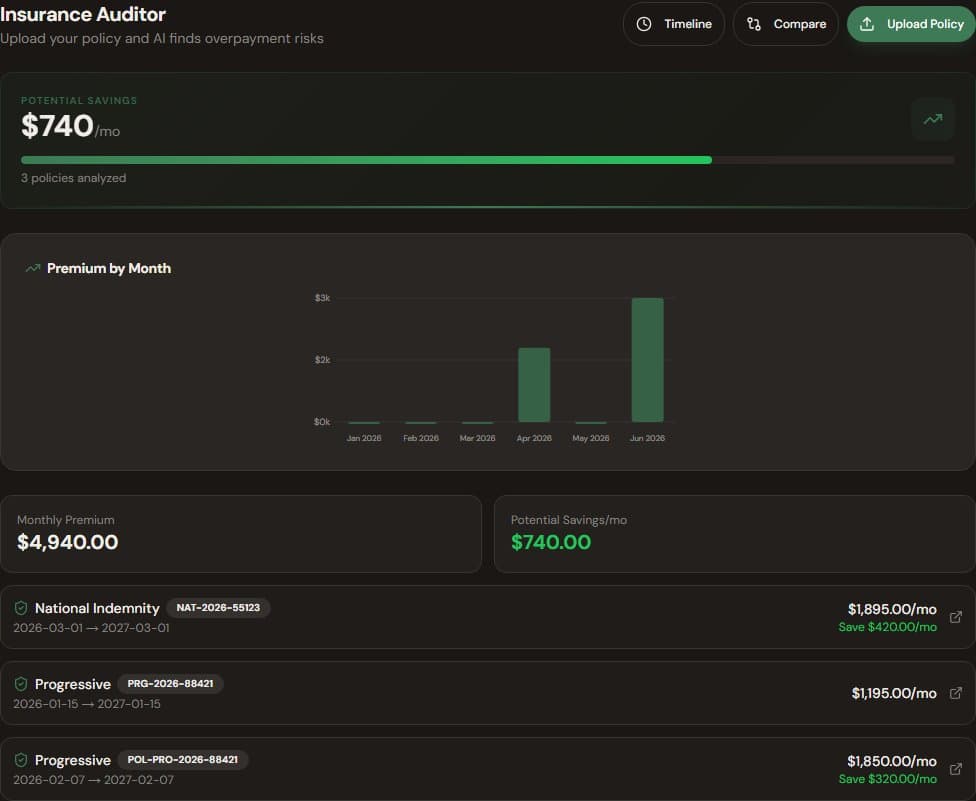
AI scans all 6 audit points in 20 seconds
- 1Upload your ACORD certificate or dec page to Insurance Auditor
- 2AI scans all 6 audit points in under 20 seconds and compares against market data
- 3You get a clear savings estimate and a ready-to-send letter to your agent
- 4Users find an average of $600/year in savings on their first upload